Advancing Participation Across the Amateur Radio Lifecycle: Enrollment, Engagement, and Retention - Draft
A Market Research Proposal to Inform ARDC's Grantmaking Strategy
Prepared by: Jim Idelson
Date: March 2026
Status: Draft
1. Executive Summary
ARDC makes substantial investments in amateur radio and digital communications not simply to fund individual projects, but to strengthen the broader ecosystem in which participation, experimentation, learning, and technical community can grow. Its decisions help shape the conditions under which new people discover amateur radio, existing participants deepen their involvement, and mission-aligned communities develop over time. As the range of opportunities before ARDC continues to expand, so does the importance of having a clear view of the ecosystem those investments are intended to influence.
ARDC already draws from the best pool of information currently available to support its investment decisions. Internally, that includes qualitative review of prior grant applications and completed projects. Externally, it includes a view of the ecosystem shaped heavily by anecdote, activity in visible communities, institutional memory, and informed intuition. Those inputs are valuable and often indispensable. But as the volume, variety, and strategic complexity of funding opportunities continue to rise, they are not enough by themselves to provide the kind of durable decision support ARDC will increasingly need to keep its investments well targeted and maximally impactful.
ARDC is right on target in asking for better information about the ecosystem that brings new participants into amateur radio and keeps them there. This is not simply a matter of curiosity or refinement. Across the community, it is not hard to find signs of friction, missed opportunities, uneven participant development, and loss of momentum after initial entry. There are success stories worth learning from, but there are also visible failures and gaps that continue to hold the community back. We are encouraged to see ARDC stepping forward with the goal of understanding these dynamics more clearly so that future investments can do more than support promising ideas individually — they can help improve the ecosystem where it is not working as well as it should.
At first glance, ARDC’s request may appear to be one unified problem: how do people come into amateur radio, and what helps keep them there? In practice, however, it contains two very different and nearly opposite challenges. One is an acquisition problem: how future participants first encounter amateur radio and digital communications, what draws them in, and which communities and pathways are most likely to produce continued participation. The other is a retention problem: how existing participants deepen their involvement, maintain it over time, or drift away from it.

Exhibit 1.1. Conceptual divider: Acquisition and Retention are connected halves of one lifecycle, with Initial Amateur Radio License as the demarcation point.
These two halves of the problem are connected, but they are not the same. One looks upstream toward entry; the other looks downstream toward continuity and exit. One side of the problem is about creating participation; the other is about sustaining it. They intersect, but they do not behave the same way, and they cannot be studied as though they do.
For that reason, this proposal is organized as two coordinated tracks. * Track 1 focuses on current and former licensees and is designed to understand engagement, tenure, drift, lapse, and exit dynamics. * Track 2 focuses on acquisition pathways through adjacent and propensity-bearing communities and is designed to identify where future participation is most likely to come from and how those pathways can be strengthened. This two-pronged solution is the natural consequence of the problem’s internal split.
Absolutely. Here is the revised three-section, paragraph-level meta-outline with the stronger acquisition/retention dichotomy built in.
I’ve preserved the key language from the last response, especially the ideas that:
- ARDC’s question sounds singular but actually contains two very different and nearly opposite challenges
- one looks upstream toward entry
- the other looks downstream toward continuity and exit
- one side is about creating participation
- the other is about sustaining it
- they intersect, but they do not behave the same way, and they cannot be studied as though they do
- the two-pronged solution is the obvious consequence of the problem’s internal split
Revised Meta-Outline for Sections 1–3
Section 1. Executive Summary
Paragraph 1 — ARDC’s mission context and why this matters now
Goal: Show that we understand ARDC’s role, ambitions, and rising strategic burden.
This paragraph should play back ARDC’s world:
- ARDC makes meaningful investments across amateur radio and digital communications
- those investments are intended to strengthen an ecosystem, not just fund isolated projects
- the volume, diversity, and complexity of funding opportunities are increasing
This is the opening that says: we understand what you are trying to do and why the stakes are rising.
Paragraph 2 — The decision problem is becoming harder
Goal: Create pressure and explain why better decision support is now needed.
This paragraph should say:
- today, ecosystem understanding often comes from anecdote, expert intuition, visible communities, and partial signals
- those inputs remain valuable, but they are not sufficient for increasingly complex allocation decisions
- if ARDC does not build a stronger base of decision-making information and tools, it will become harder and harder to keep investments on target and as impactful as possible
This is where we say, clearly but professionally, that decision-making will get more difficult as demand pressure rises.
Paragraph 3 — Echo back ARDC’s question and affirm that it is the right one
Goal: Show alignment and make the reader feel understood.
This paragraph should say:
- ARDC asked for better understanding of the ecosystem that brings new participants into amateur radio and keeps them there
- that is the right question because it focuses on the participation system itself, not just isolated programs or anecdotes
- understanding only entry, or only persistence, would leave major strategic blind spots
This is the hinge from ARDC’s request to our framing.
Paragraph 4 — Reveal the hidden dichotomy inside ARDC’s question
Goal: Show that what sounds like one problem is actually two very different and nearly opposite strategic problems.
This paragraph is crucial.
It should say:
- at first glance, ARDC’s question sounds singular
- in practice, it contains two very different and nearly opposite challenges
- one is an acquisition problem: how future participants first encounter amateur radio and digital communications, what draws them in, and which communities and pathways are most likely to produce continued participation
- the other is a retention problem: how existing participants deepen their involvement, maintain it over time, or drift away from it
- one looks upstream toward entry
- the other looks downstream toward continuity and exit
- one side of the problem is about creating participation
- the other is about sustaining it
- they intersect, but they do not behave the same way, and they cannot be studied as though they do
This paragraph should make the two-pronged solution feel inevitable.
Paragraph 5 — Present the two-track solution as the natural answer
Goal: Show that the structure of the proposal is a consequence of the dichotomy, not a convenience.
This paragraph should say:
- because these two halves of the problem involve fundamentally different populations, evidence conditions, and decision needs, the proposal is organized as two coordinated tracks
- Track 1 addresses current and former licensees
- Track 2 addresses acquisition pathways from adjacent and propensity-bearing communities
- the two-pronged solution is the obvious consequence of the problem’s internal split
This is the structural reveal.
Paragraph 6 — Concise summary of Track 1
Goal: Introduce the first half of the answer in a confident, useful way.
This paragraph should say:
- Track 1 focuses on current and former licensees
- it is designed to understand engagement, tenure, drift, lapse, and exit dynamics
- it provides the strongest evidentiary footing in the proposal and establishes a decision-grade baseline for the licensed core
Keep this compact and sponsor-facing.
Paragraph 7 — Concise summary of Track 2
Goal: Introduce the second half of the answer and make the contrast clear.
This paragraph should say:
- Track 2 focuses on acquisition pathways from adjacent communities with a propensity to produce future participants
- these populations do not sit under a single umbrella definition and cannot be approached as though they do
- the output is not false precision, but confidence-bounded insight into where future participation is most likely to come from and how ARDC can influence those pathways
This is the parallel to Paragraph 6.
Paragraph 8 — What ARDC gets
Goal: Turn the proposal into value and momentum.
This is the best place for a short bullet list.
Lead-in sentence: At the end of this program, ARDC will have:
Then 3–4 bullets such as:
- a clearer map of how participation is acquired, sustained, weakened, and lost,
- a stronger basis for deciding where investment is most likely to have practical leverage,
- a more durable measurement baseline for future decision-making and evaluation,
- integrated tools and reporting that translate findings into action.
This is the payoff moment.
Paragraph 9 — Realistic close and transition
Goal: Build trust, set scope honestly, and hand off to Section 2.
This paragraph should say:
- this is a disciplined decision-support program, not a claim to prove causality everywhere
- the work is staged, practical, and designed to generate useful outputs throughout
- the next sections explain how the underlying research problem was broken down and why the two-track design follows naturally from that analysis
This should close with confidence and flow.
Section 2. Framing the Research Problem
This section should now feel like a deeper unpacking of Paragraph 4 from the Executive Summary.
Paragraph 1 — The apparent single question is really a system question
Goal: Reframe ARDC’s ask as a structured participation-system problem.
This paragraph should say:
- “bringing people in and keeping them there” sounds simple
- in practice it spans multiple stages of the participation system
- it includes upstream entry, downstream persistence, weakening engagement, and exit
- that makes it a system question rather than a single survey question
This paragraph opens the analytical frame.
Paragraph 2 — The retention-side population domain
Goal: Explain why current and former licensees belong together as one research domain.
This paragraph should say:
- current and former licensees share a direct relationship to amateur radio as a licensed activity
- for this group, the central questions concern engagement, tenure, drift, lapse, and retrospective accounts of exit
- here, “licensed ham” is itself a meaningful population definition
This is where we emphasize the nature of the population, not the existence of the ULS.
Paragraph 3 — The acquisition-side population domain
Goal: Explain why future participants are a fundamentally different research problem.
This paragraph should say:
- there is no single umbrella category that can be cleanly defined as “prospective hams”
- future participants emerge from a mix of communities with different interests, identities, and entry points
- the task is therefore to identify and profile communities with a propensity to produce future participants
This paragraph should be one of the anchors of the whole proposal.
Paragraph 4 — Why the two domains are structurally different
Goal: Make the dichotomy more explicit in analytical terms.
This paragraph should say:
- the two domains differ in definition, accessibility, motivations, and evidence structure
- one begins with people already inside or partly inside the system
- the other begins with people not yet inside the system
- one asks how participation is sustained, weakened, or lost
- the other asks how participation is first created
- these are connected questions, but they are not symmetrical in method or evidence
This is the logic paragraph.
Paragraph 5 — Why one unified design would weaken the answer
Goal: Make the split feel not just reasonable, but necessary.
This paragraph should say:
- forcing both domains into a single design would blur important distinctions
- it would weaken both the retention-side analysis and the acquisition-side exploration
- the right answer is a coordinated design with two different approaches, each matched to the population it is trying to understand
This is the “therefore” paragraph for Section 2.
Paragraph 6 — What unifies the two domains
Goal: Prevent the proposal from feeling fragmented.
This paragraph should say:
- although the domains are different, they are part of the same participation system
- one explains continuity within amateur radio
- the other explains the pathways through which future continuity can begin
- ARDC needs both to make better decisions about where to place its bets
This is the coherence paragraph.
Paragraph 7 — Transition to the program design
Goal: Hand off naturally to Section 3.
This paragraph should say:
- the proposal therefore responds with two coordinated but deliberately different tracks
- the next section outlines that design and explains how the tracks relate to one another
Short and clean.
Section 3. Program Design Overview
This section should feel like the architecture reveal: “here is the shape of the answer.”
Paragraph 1 — Present the two-track program clearly
Goal: Introduce the structure of the response.
This paragraph should say:
- the program is organized as two primary tracks
- Track 1 addresses current and former licensees
- Track 2 addresses acquisition pathways from adjacent and propensity-bearing communities
- the tracks are intentionally different because the populations and decision questions are different
This is the architecture statement.
Paragraph 2 — What Track 1 is designed to produce
Goal: Give the reader a concise preview of Track 1.
This paragraph should say:
- Track 1 produces a decision-grade baseline for the licensed core
- it focuses on engagement, retention, drift, lapse, and exit dynamics
- it is designed to identify patterns that help ARDC understand weakening connection before complete disengagement occurs
Keep it high-level and compelling.
Paragraph 3 — What Track 2 is designed to produce
Goal: Give the reader a concise preview of Track 2.
This paragraph should say:
- Track 2 identifies and profiles communities and pathways with the strongest practical potential to produce future participants
- it is built to help ARDC understand where to focus upstream experimentation, partnership, and pathway development
- it treats the acquisition side of the problem honestly, using segmented and confidence-bounded approaches rather than pretending a single representative frame exists
This should contrast naturally with Paragraph 2.
Paragraph 4 — Explain the confidence posture across the two tracks
Goal: Set expectations honestly and early.
This paragraph should say:
- the two tracks do not carry identical evidentiary strength, and that is by design
- Track 1 provides the strongest footing for defensible measurement and repeatable baselining
- Track 2 provides directional, action-guiding insight in a more fragmented and exploratory landscape
- the proposal is explicit about those differences rather than masking them
This is a trust-building paragraph.
Paragraph 5 — Introduce the full-system figure
Goal: Give the reader a visual map of the territory.
This paragraph should say:
- the figure below presents the participation system at a high level
- it shows how upstream communities, entry pathways, licensing, engagement, drift, and longer-term tenure relate to one another
- later sections will zoom in on the parts most relevant to each track
This is where the full diagram should appear.
Paragraph 6 — Explain why the tracks are stronger together
Goal: Introduce integration early enough that the proposal does not feel split in two.
This paragraph should say:
- Track 1 and Track 2 answer different questions, but they are more useful together than apart
- one explains how participation is sustained or lost within the licensed core
- the other explains where future participation may come from and how pathways can be strengthened
- together they create a fuller basis for decision-making than either could alone
This paragraph seeds the later integration section.
Paragraph 7 — Transition to the track sections
Goal: Move the reader smoothly into Sections 4 and 5.
This paragraph should say:
- the sections that follow provide concise overviews of each track
- detailed methods and supporting notes are moved to the appendices
- the proposal turns first to Track 1, then to Track 2, and then to how the two are integrated
Short, clear, and forward-moving.
Best Storytelling Flow Across the Three Sections
This revised structure now has the flow you wanted:
Section 1: This matters → ARDC is asking the right question → that question secretly contains two nearly opposite problems → therefore the solution must be two-pronged
Section 2: Here is why those two halves are structurally different in population terms and cannot be studied the same way
Section 3: Here is the two-track architecture that follows naturally from that dichotomy
Key phrases we should preserve in actual drafting
These should absolutely survive into the prose:
- two very different and nearly opposite challenges
- one looks upstream toward entry
- the other looks downstream toward continuity and exit
- one side of the problem is about creating participation
- the other is about sustaining it
- they intersect, but they do not behave the same way, and they cannot be studied as though they do
- the two-pronged solution is the obvious consequence of the problem’s internal split
These are excellent framing lines and should become part of the actual narrative voice.
The next strong move is to turn this meta-outline into actual draft prose for Sections 1–3.
1. Title + Executive Summary (S0)
TODO: Curate the strongest decision-first summary from quarry Sections 1-3 and 12 into a two-page sponsor-facing opening. TODO: Keep this section table/bullet-led and explicitly point to the two coordinated tracks plus optional continuity.
2. What ARDC Asked Us (S1)
ARDC invests roughly $4-$5 million per year across amateur radio and digital communications projects. As ARDC becomes more widely known, the volume, breadth, and ambition of funding requests continues to rise-while funds remain scarce. With that growth comes an increasing sense of responsibility: to pick the right projects, to make better choices every cycle, and to maximize the productivity and return on the dollars invested across the ecosystem.
That responsibility raises a practical question: how can ARDC know where to invest, what to prioritize, and what kinds of outcomes are realistic to expect? ARDC has substantial anecdotal knowledge-from grant activity, community insiders, VEs, clubs, and online participation. That knowledge is valuable, but it is not a substitute for representative evidence. It cannot reliably answer how generalizable those observations are, how much variation exists beneath the surface, or whether the patterns that feel obvious hold across the full population. The anecdotal picture is a starting point; systematic research is what makes it decision-grade.
%%{init: {
  "flowchart": { "useMaxWidth": true, "nodeSpacing": 70, "rankSpacing": 120, "curve": "basis" },
  "themeVariables": { "fontSize": "18px", "nodePadding": 16 }
}}%%
flowchart LR
  subgraph W["Without This Research"]
    direction TB
    W1["Partial signals"]
    W2["Investment decisions"]
    W3["Unclear outcomes"]
    W1 --> W2 --> W3
  end

  subgraph R["With This Research"]
    direction TB
    R1["Research-grounded understanding"]
    R2["Targeted investment decisions"]
    R3["Measured outcomes"]
    R4["Refined strategy"]
    R1 --> R2 --> R3 --> R4
  end

  W -. this proposal .-> R
Exhibit 2.1: Research benefits for ARDC - stronger targeting, measurable outcomes, and strategy refinement.
ARDC's grantmaking is itself a form of structured experimentation: fund efforts, learn what works, iterate. This research strengthens that cycle by first establishing a shared, quantitative understanding of the community: who participates, what motivates them, where engagement deepens or drops off, and which adjacent populations represent realistic future pathways.
This is not research for its own sake. The aim is not merely to produce interesting findings, but to drive decisions-where to invest, which challenges to prioritize, and how to evaluate whether ARDC's portfolio is producing the outcomes it intends.
3. How We Shaped the Response (S2)
ARDC's decision needs span two mutually exclusive subject domains, which we address as two coordinated tracks within an otherwise end-to-end research program. The first track focuses on people who already hold (or previously held) an amateur radio license, where ARDC can quantify engagement, retention, and reactivation patterns. The second focuses on people who do not hold an amateur radio license-adjacent and affinity communities that represent plausible future pathways into licensing. These domains connect conceptually (pathways into licensing shape downstream participation), but they are different populations with different access structures, so they require different evidence strategies.
Track 1: Licensed population (engagement, retention, reactivation). On the licensed side, ARDC's questions are: Who is here? How do they participate? Why do they stay, drift away, or return? This domain supports a more defensible population-based approach because a strong frame exists for U.S. licensees and many former licensees (via FCC records), enabling credible segmentation and estimates that can serve as a baseline for future evaluation.
Track 2: Pre-license pathways (adjacent and affinity communities). On the pre-license side, ARDC's challenge is not "one community," but a heterogeneous landscape of adjacent technical and affinity groups with partial overlap in motivations and skills. Here the goal is to identify where future participants are most likely to come from, what attracts them, and what routes into licensing are most realistic. Because frames vary by community, this track combines scalable sources where possible with targeted approaches where enumeration is hard.
Integration across tracks. Because the two domains are linked, we design the tracks to connect: insights about pre-license motivations and barriers are interpreted alongside licensed-side engagement trajectories, so ARDC can see how entry pathways relate to downstream participation and persistence.
Optional continuity: reusable measurement over time. Finally, ARDC's grantmaking is iterative. Where feasible, we shape outputs so that key measures can be repeated in future cycles (a baseline now, then periodic refreshes), allowing ARDC to track change and assess whether the portfolio is moving the intended outcomes over time.
The next section describes the integrity controls and confidence posture applied across both tracks.
4. Methodological Integrity and Confidence Posture (S3)
Central to the value of this work product is the confidence ARDC can place in the findings. We design for that confidence explicitly: we start from frame quality, then build disciplined instruments, then gate major steps through pilots and checks before scaling. We will report results with the level of certainty they warrant-clearly distinguishing decision-grade estimates from directional insight-and we will be transparent about limitations and assumptions.
What changes by domain is the confidence posture:
- Track 1 (licensed, post-grant): ULS-based probability sampling supports population-level estimates when design assumptions are met.
- Track 2 (pre-license and adjacent domains): no single master list exists, so results are reported as segmented, directional, and confidence-bounded by source.
Shared integrity controls across both tracks include multi-touch field operations where applicable, non-response/bias checks, neutral instrument design, cognitive testing and pilot gating, privacy/PII separation, and open-data publication terms agreed at Charter.
This is a decision-support program, not a causality proof program: findings support evaluation readiness and plausible contribution tracking, with explicit limits where representativeness is constrained.
5. Common Definitions and Success Criteria (S4)
5.1 Common Definitions
These terms are used consistently across both tracks.
Enrollment (pre-license pathway): the progression from awareness of amateur radio and adjacent AR/DC opportunities, to exploration/experimentation (first steps, learning, trial activity), to a commitment step such as pursuing a license (Initial Grant) or sustained participation in adjacent AR/DC pathways where licensing is not the immediate goal.
Engagement (post-grant): the depth and continuity of participation after Initial Grant (activity frequency, mode diversity, learning progression, community participation, and contribution behaviors).
Retention: sustained engagement over time, including renewal continuity and reduced drift/lapse risk. Reactivation is a return to meaningful participation after drift or lapse.
5.2 Success Criteria (for ARDC decision support)
Because the domains differ, "success" is defined by the decisions ARDC needs to make in each domain:
Track 1 (Engagement & Retention) succeeds when ARDC can measure lifecycle patterns with high confidence and identify the most actionable levers for engagement continuity, retention risk reduction, and reactivation within the licensed population.
Track 2 (Enrollment Pathways) succeeds when ARDC gains a credible view of which communities are most promising, what messages and entry experiences increase exploration/experimentation and continuation, and where ARDC investments can most plausibly improve entry pathways. Licensing (Initial Grant) is one useful metric, but not the only outcome.
6. Evidence Sources at a High Level (S5)
No single reachable source of participants-a "frame"-covers the full decision space in this proposal. We therefore use a portfolio of populations and frames, choosing the strongest available source for each question and being explicit about confidence where frames are fragmented.
Population 1: Current Licensees
Decision relevance: Understand engagement distribution within current licensees.
Signal examples: Activity level, mode diversity, renewal intent.
Primary access: FCC ULS mail-to-web.
Population 2: Former Licensees
Decision relevance: Identify reactivation opportunities and barriers to return.
Signal examples: Expiration drivers, return intent, re-entry friction.
Sub-population: Grace-period licensees (still eligible for fee-only reinstatement).
Primary access: Historical FCC ULS + data hygiene + mail-to-web.
Population 3: Adjacent and Affinity Communities
Decision relevance: Prioritize pre-license pathways with highest practical potential.
Signal examples: Awareness, receptivity, first-step participation.
Primary access: Partner networks + targeted outreach + screened panels.
Population 4: Digital Communications Practitioners
Decision relevance: Improve ARDC fit and impact in non-licensed DC communities.
Signal examples: Collaboration patterns, tooling barriers, support needs.
Primary access: Open-source communities + technical channels + practitioner panels.
Population 5: General Population Benchmark (Optional)
Decision relevance: Directional context for awareness and receptivity baselines.
Signal examples: Unaided awareness, interest, perceived relevance.
Primary access: Benchmark-oriented online panel module.
Exhibit 6.1. Population Segmentation Cards - five populations, decision relevance, and primary access method.
Interpretation note: Populations 1-2 (licensed and former licensed) support decision-grade estimation because the frame is enumerable and outreach can be statistically defended. Populations 3-4 are inherently more fragmented, so we use a multi-source approach and report results with explicit confidence bounds and segment-level caveats. The intent is not uniform precision everywhere, but maximum decision value per dollar by using the strongest available frame for each question.
The general population module is optional and directional; we prioritize technical-adjacent and practitioner segments where ARDC can act directly and where decision value per dollar is highest.
7. Track 1: Engagement, Retention, and Reactivation
The purpose of Track 1 is to give ARDC a decision-grade baseline on who is participating today, where engagement is strong or fragile, which segments appear most at risk of drift or lapse, and where retention efforts are most likely to have practical leverage. Without that baseline, ARDC is left to guess about population dynamics, with clues coming only from the most visible participants and the noisiest signals. With it, ARDC gains a more defensible basis for prioritization, measurement, and future evaluation. Track 1 is the anchor workstream in this proposal. It addresses the part of ARDC’s decision problem where the evidence can be strongest: the licensed and formerly licensed amateur radio population.
Track 1 at a glance
- Frame: FCC ULS current and historical license records
- Approach: Staged mixed-method design with qualitative shaping, survey fielding, and bounded trajectory analysis
- Primary outputs: Licensed-population snapshot, engagement and retention insights, identification of common new licensee trajectories, and reusable baseline measures
- Confidence posture: Strongest evidentiary footing in the proposal
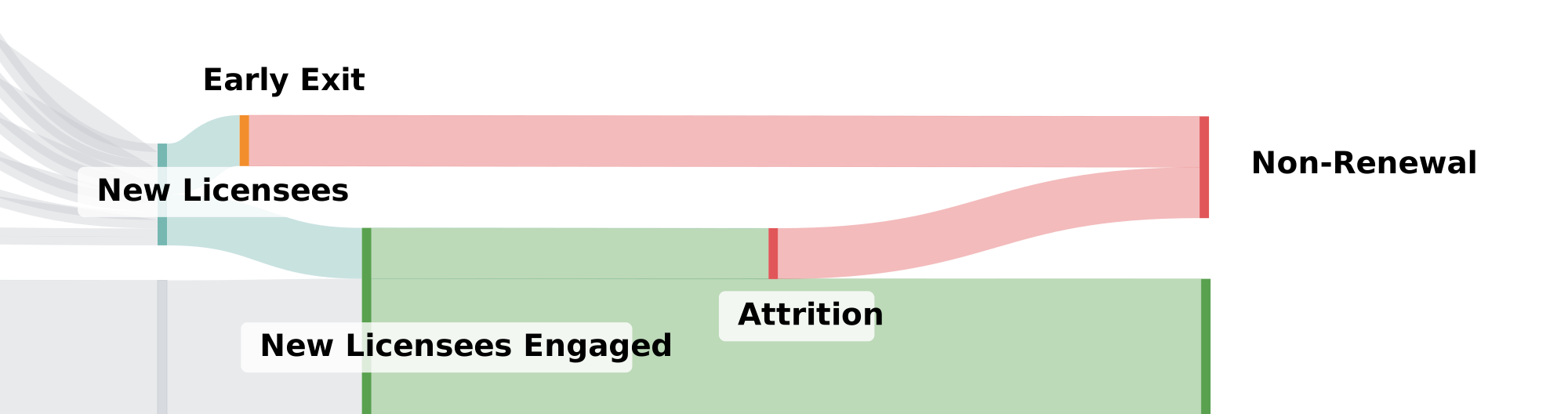
Exhibit 7.1. After-license view: post-grant engagement, attrition, and renewal flows with pre-license inputs muted.
A central feature of Track 1 is the development of an engagement metric built as a continuous scale rather than a simple active/inactive split. Amateur radio participation can take many forms, and ARDC needs a measure that reflects that reality. The scale is intended to blend multiple modes of engagement, including operating activity, designing and building, experimentation, and studying or teaching amateur-radio-related topics. This gives ARDC a more realistic way to describe where people sit along an engagement continuum and to identify where weakening participation may begin before it shows up as complete disengagement.
What makes Track 1 different is the availability of a practical population frame. In the United States, the FCC ULS makes it possible to reach beyond clubs, online communities, contests, and other high-engagement channels and instead draw from the full licensed population, including less-visible and less-active operators whose experiences are essential to understanding drift, inactivity, and return. That does not remove all design risk, but it materially improves ARDC’s ability to produce credible estimates, useful segmentation, and a baseline that can be refreshed over time. ULS is used here for research access and sample construction, with privacy protections and aggregate-only reporting aligned to the proposal’s data stewardship commitments.
Track 1 produces two complementary lenses on the licensed population. The first is a community snapshot: a decision-grade picture of where licensees fall along the engagement continuum, what forms their participation takes, and which barriers appear to constrain deeper involvement. The second is a trajectory view: a bounded analytical layer that helps ARDC understand how different segments arrived where they are today, including common patterns of early momentum, steady participation, drift, and weakening connection to the hobby. The combination matters because ARDC does not only need to know where problems exist; it needs to know where they begin, where they intensify, and where intervention is still likely to matter.
Exhibit 7.1 provides the mental model for this work. It links the licensed lifecycle to common engagement trajectories and shows how the community snapshot and the trajectory layer work together. The snapshot is the guaranteed output. Trajectory analysis is explicitly bounded and will be developed only to the extent the data support defensible interpretation. That distinction is important to the integrity of the work: Track 1 is designed to produce a reliable baseline first, then a more interpretive view of journey patterns where the evidence warrants it.
Track 1 follows a staged design rather than jumping directly to broad fielding. Qualitative discovery is used first to sharpen vocabulary, instrument structure, and pathway framing. Quantitative fielding then proceeds through a ULS-based mail-to-web model designed to improve reach beyond digitally visible participants. Former licensees are included not because reactivation is assumed to be a major near-term lever, but because their retrospective accounts can reveal where participation broke down, what barriers proved durable, and what kinds of change might have been required to keep them connected. In the main body of the proposal, the key point is simple: this track is built to maximize decision value from the strongest available frame. Detailed field operations and methodological specifications are provided in the appendix.
Track 1 gives ARDC a decision-grade view of:
- where engagement is strong, fragile, or already slipping,
- which segments appear most exposed to lapse or drift,
- what kinds of barriers and breakpoints are most associated with weakening engagement,
- which measures are strong enough to reuse in future waves.
The output of Track 1 is not just a report about current licensees. It is a practical decision package for ARDC: where lifecycle risk appears concentrated, which segments warrant retention attention, what forms of engagement are most resilient or most vulnerable, what former licensees can teach us about where the system loses people, and which measures can anchor future tracking. This is the track that gives ARDC its clearest baseline for understanding the licensed core of the ecosystem and for assessing whether future grantmaking is plausibly changing outcomes over time.
8. Track 2: Acquisition Pathways
Track 2 addresses the part of ARDC’s decision problem that sits outside the currently licensed population: where future participation is most likely to come from, which adjacent communities are already meaningfully aligned with ARDC’s mission, and what kinds of pathways, messages, and partner strategies are most likely to increase exploration, experimentation, and continued movement toward participation. This track matters because ARDC’s opportunity is not limited to supporting people who are already in the licensed amateur radio community. It also includes strengthening the pathways through which future operators, builders, experimenters, and contributors first encounter amateur radio and digital communications.
Track 2 at a glance
- Frame: Segmented adjacent and affinity communities; no single master frame
- Approach: Source-qualified, mixed-method pathway research across selected segments and partner-access channels
- Primary outputs: Acquisition pathway opportunity map, confidence-bounded findings on messages and partner routes, segment-level opportunity assessment, and Track 2 decision inputs
- Confidence posture: Intentionally variable by segment and source; designed for directional and action-guiding insight rather than universal population estimates
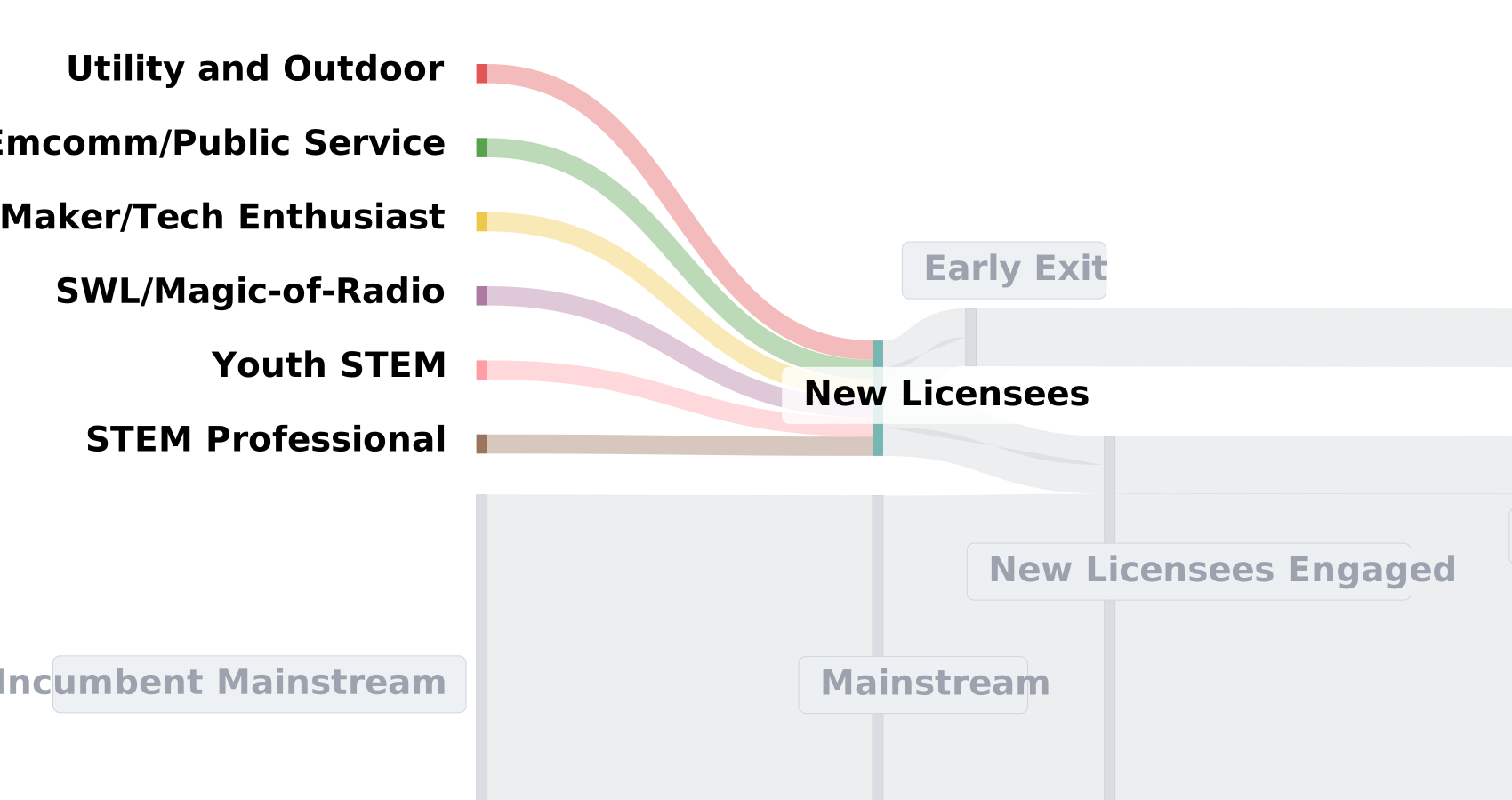
Demo. Responsive D3 Sankey test chart (for rendering validation only).
Unlike Track 1, Track 2 does not benefit from a single master frame. There is no equivalent to FCC ULS across the technical-adjacent, maker, preparedness, and digital communications populations relevant to ARDC. That reality shapes the design directly. Track 2 is intentionally segmented, source-qualified, and confidence-bounded. Its job is not to overclaim representativeness where representativeness is not available. Its job is to help ARDC act more intelligently in fragmented terrain by identifying which segments are most promising, which pathways appear most investable, and which inferences are strong enough to support targeted experimentation and partnership choices.
The acquisition-pathways figure should appear early in this section as the orienting system map. It shows that this track is not about a single funnel or a single conversion event. It is about multiple points of entry into AR/DC participation, some of which may lead toward amateur radio licensing and some of which may lead toward adjacent but mission-aligned forms of technical experimentation and contribution. That is why Track 2 success is broader than conversion to licensed amateur radio alone. Initial licensing is one useful metric, but the larger success frame is movement along a learn-experiment-do continuum in pathways that ARDC can realistically influence.
Within that broad frame, several segments stand out as especially relevant: STEM and maker communities, consumer and specialized radio users, emergency preparedness and community-service volunteers, and digital communications practitioners. These groups differ in how reachable they are, how closely they overlap with amateur radio, and how naturally they align with ARDC’s goals. That variation is not a flaw in the design; it is the reason Track 2 must be segmented in the first place. The work of this track is to qualify access routes, define the confidence posture for each segment, gather pathway-relevant qualitative and quantitative evidence, and synthesize it into an opportunity map ARDC can use.
Track 2 success is broader than initial licensing alone. It includes:
- stronger awareness in relevant technical and maker audiences,
- increased hands-on experimentation and pathway participation,
- clearer continuation intent among promising segments,
- better evidence on which partner channels and messages deserve investment.
Exhibit 8.1 provides the workflow model for this track. It begins with segment prioritization and access strategy, then moves through source qualification, instrument shaping, fielding, and cross-segment synthesis. The logic is straightforward: first determine where evidence is realistically obtainable, then decide what claims that evidence can support, then use those findings to guide pathway investment, partner strategy, and message development. This is the disciplined alternative to either guessing or pretending that all adjacent populations can be studied with the same level of confidence.
The main outputs of Track 2 are practical. ARDC receives a segment-prioritized opportunity map, confidence-bounded findings about pathways and messages, a clearer view of which partner channels can accelerate progress most quickly, and a Track 2 decision component that can later be integrated with Track 1. The result is not a universal statement about all future participants. It is a more credible basis for deciding where ARDC should place bets upstream of the licensed core, where experimentation appears worth funding, and where expectations should remain modest.
9. How the Tracks Come Together (I1)
TODO: Curate integration logic from quarry Sections 5, 9, and 12; focus on how outputs from both tracks improve decisions together. TODO: Keep this as practical integration, not abstract synthesis prose.
10. What Comes Later (I2)
TODO: Curate continuity logic from quarry Sections 13-14 and relevant deliverables language; continuity must remain optional and gated. TODO: Keep activation language tied to post-Decision Kit timing.
11. Governance and Decision Gates (I3)
TODO: Pull governance structure from quarry Sections 6 and 10 with concise gate responsibilities and approvals. TODO: Keep this section compact and table-forward where possible.
12. Deliverables, Timeline, Investment, and Options (I4)
ARDC receives substantive outputs throughout the program, not only at close. Contracted scope and pricing are finalized before start; Charter then refines execution sequencing within the contracted scope.
12.1 Deliverables by Phase
| Phase | Primary deliverables |
|---|---|
| Charter and design lock | Signed Charter document (scope, values, participation, design decisions) |
| Track 1 qualitative phase | Track 1 Qualitative Findings Report |
| Track 1 quantitative phase | Track 1 Survey Report; Track 1 Decision Kit component |
| Expert interviews (running) | Rolling interview summaries; Expert Interview Synthesis |
| Track 2 qualitative phase | Track 2 Qualitative Findings Report (optional directional benchmark module if included) |
| Track 2 quantitative phase | DC Community Report; Track 2 Survey Report |
| Final integration | Full Decision Kit; Open Data Package; repeatable question bank and cohort design documentation (Core tier and above) |
12.2 Timeline Framework (ranges)
- Phase 0 (Charter and design lock): 3 to 5 weeks
- Track 1 qualitative + instrument + pilot: 6 to 10 weeks
- Track 1 quantitative fielding + analysis: 8 to 12 weeks
- Track 2 design and fielding (Plus/Max): 8 to 14 weeks, partially overlapping with late Track 1 tasks
- Integrated synthesis and Decision Kit: 4 to 6 weeks
Typical elapsed duration by tier:
- Core: approximately 5 to 7 months
- Plus: approximately 7 to 9 months
- Max: approximately 9 to 12 months (including longitudinal and dashboard design work)
12.3 Tier Structure (exact posture from quarry)
- Core - Know Your Community (Core Program): licensed and previously licensed populations (Track 1 only)
- Plus - See the Whole Ecosystem (Technical Depth Expansion): adds adjacent populations, digital communications practitioners, and optional general benchmark (Track 2 added to Core)
- Max - Build the Machine (Longitudinal Extension): adds longitudinal infrastructure, interactive dashboard, and Wave 2 planning
| Capability | Core | Plus | Max |
|---|---|---|---|
| Licensed community (Track 1) | Yes | Yes | Yes |
| Adjacent communities and digital communications practitioners (Track 2) | No | Yes | Yes |
| General population benchmark (directional, optional) | No | Optional | Optional |
| Expert interviews (targeted) | Yes | Yes (expanded) | Yes (expanded) |
| Integrated cross-track analysis | No | Yes | Yes |
| Interactive data dashboard | No | No | Yes |
| Longitudinal design documentation | Seed | Seed | Full |
| Wave 2 plan | No | No | Yes |
| Open data (dataset, codebook, instruments) | Yes | Yes | Yes |
12.4 Investment Logic and Cost Drivers
Investment is governed by a small number of drivers, not arbitrary package labels:
- target sample sizes and required sub-group cell sizes
- invitation wave/reminder intensity for Track 1 mail-to-web
- panel sourcing and screening complexity for Track 2
- incentive model and response-rate support level
- instrument complexity, branching depth, and pilot iteration count
- analysis depth, cross-tab breadth, and synthesis scope
- optional deliverables (dashboard, Wave 2 planning depth, international extension)
Detailed budget values are finalized in contracting prior to kickoff and tied to the agreed tier and add-on scope. Charter confirms timing and implementation assumptions so execution begins with both commercial clarity and methodological discipline.
13. About Jim (I5)
TODO: Pull trimmed credibility profile from quarry Section 15, focused on role fit for this program. TODO: Keep to short reviewer-relevant proof points only.
14. Builder: Topic Inventory Map (Temporary)
| Content block/topic | Where it exists now (Proposal.md) | Target home (Section) | Action | Notes |
|---|---|---|---|---|
| Executive summary core value proposition | Section 1 | 1 (S0) | SHRINK | Decision-first opening, 2-page cap target |
| ARDC goals and project role | Section 2 | 2 (S1) | MOVE | Core challenge framing |
| Decision map table (licensed population) | Section 3 | 2 (S1) | SHRINK | Pull only decision-relevant rows |
| Decision map table (never-licensed/adjacent) | Section 3 | 2 (S1) | SHRINK | Keep clear boundaries, no overclaims |
| Locked commitments block | Section 3 | 4 (S3) | MOVE | Fidelity anchor for confidence language |
| Option structure statement (Core/Plus/Max) | Section 3 and 14 | 12 (I4) | KEEP | Must match commitments exactly |
| Population strategy opening paragraph | Section 4 intro | 6 (S5) | MOVE | High-level portfolio framing |
| Exhibit 4.1 population cards | Section 4 | 6 (S5) or 8 (W2) | KEEP | Use once only; avoid duplication |
| Population 1 definition and decision relevance | Section 4 | 7 (W1) | SHRINK | Keep only what drives W1 design |
| Population 2 definition incl. grace period | Section 4 | 7 (W1) | SHRINK | Frame as lower-friction opportunity |
| Population 3 adjacent communities details | Section 4 | 8 (W2) | SHRINK | Segment examples only as needed |
| Population 4 digital communications practitioners | Section 4 | 8 (W2) | KEEP | Non-license-centered value |
| Population 5 optional benchmark posture | Section 4 | 6 (S5) | KEEP | Optional/directional/deprioritized |
| Cross-tab and sample size caveat | Section 4 | 4 (S3) | SHRINK | Integrity note only |
| Community snapshot framing | Section 4 ("Community Snapshot") | 7 (W1) | KEEP | Early W1 narrative anchor |
| Engagement trajectory framing | Section 4 ("Engagement Trajectories") | 7 (W1) | KEEP | Bridge from snapshot to trajectories |
| Trajectory caution (recall limits) | Section 4 | 7 (W1) | KEEP | Explicit honesty statement |
| Exhibit 4.2 lifecycle/trajectory figure | Section 4 | 7 (W1) | MOVE | Place early in W1 as mental model |
| Program overview and staggered design | Section 5 | 3 (S2) | SHRINK | Two coordinated efforts + boundaries |
| Exhibit 5.1 timeline | Section 5 | 9 (I1) or 12 (I4) | MOVE | Keep if it improves integration/timing read |
| Phase 0 charter alignment | Section 6 | 11 (I3) | SHRINK | Governance and gates input |
| Track 1 narrative | Section 7 | 7 (W1) | KEEP | Primary W1 source section |
| Exhibit 7.2 Track 1 workflow | Section 7 | 7 (W1) | KEEP | Place after W1 model framing |
| Track 2 narrative | Section 8 | 8 (W2) | KEEP | Primary W2 source section |
| Exhibit 8.2 Track 2 workflow | Section 8 | 8 (W2) | KEEP | Place early as W2 mental model |
| Expert interviews function | Section 9 | 9 (I1) | SHRINK | Integration support only |
| Governance and decision gates table | Section 10 | 11 (I3) | KEEP | Shared governance structure |
| Validity and bias controls | Section 11 | 4 (S3) | SHRINK | Method integrity summary only |
| Deliverables inventory | Section 12 | 12 (I4) | KEEP | Table-first presentation |
| Data-driven culture/continuity narrative | Section 13 | 10 (I2) | SHRINK | Optional continuity module only |
| Scope and program options | Section 14 | 12 (I4) | KEEP | Preserve Core/Plus/Max boundaries |
| About Jim profile | Section 15 | 13 (I5) | SHRINK | Short credibility section |
| Timeline and investment ranges | Section 16 | 12 (I4) | KEEP | Ranges and cost drivers, no false precision |