What Drives Participation in Amateur Radio and Digital Communications?
A Market Research Proposal to Inform ARDC's Grantmaking Strategy
Prepared by: Jim Idelson
Date: March 2026
Status: Draft
Executive Summary
Amateur radio is undergoing its most profound transformation since its inception. This isn't gradual evolution—it's rapid, fundamental change reshaping how people discover, learn, and participate in the hobby. Three unstoppable forces drive this transformation:
-
Disruptive Technologies have democratized innovation. Teenagers design advanced radio projects in their basements and sell them online. More contacts happen in a single day on FT8 than in a month on all other modes combined. Digital modes seamlessly blend RF and internet paths.
-
Universal Internet has erased traditional boundaries. Linked voice networks connect local handhelds to global communities. Contest and DXpedition stations are accessible to operate from anywhere with an internet connection.
-
Social Learning Revolution has transformed how knowledge spreads. YouTube channels replace traditional elmers. Massive online communities share expertise instantly. Virtual clubs include members and guest speakers without regard for time zones. Ham radio has gone outdoors with tiny, performant radios designed by community-driven innovation.
In this rapidly transforming landscape, ARDC is uniquely positioned in its ability to accelerate positive change at scale. Your goal is clear: invest in programs that encourage new people to enter amateur radio and ensure they can learn, experiment and contribute productively and with enjoyment over time. With significant resources and strategic focus, ARDC can help ensure these transformative forces strengthen rather than fragment the community.
But the power to influence comes with the expectation of visible and measurable impact. Today, ARDC must navigate these forces of change with every grant proposal you review and fund. You know you have a responsibility to channel funding toward activities that best support amateur radio's future. Yet there's friction: a gap in understanding of the workings of this rapidly changing ecosystem makes it harder to place strategic bets with confidence.
The Decision Support Gap
Today, ARDC (like most stakeholders in this space) relies on a mix of anecdote, proxy signals, and insider intuition. Those inputs are valuable—often indispensable—but they're not enough to support the kind of strategic capital allocation and outcome measurement ARDC increasingly needs. Two critical capabilities are required, with a third opportunity emerging over time:
-
Evidence-Based Investment Strategy
- Move from intuition to data-driven decisions
- Build clear frameworks for proposal evaluation
- Establish baselines for measuring impact
- Enable confident portfolio management
-
Proactive Leadership
- Shift from responding to shaping
- Identify strategic opportunities early
- Target high-leverage intervention points
- Accelerate positive transformation
-
Knowledge Leadership (over time)
- Become the authoritative source of insight
- Guide community understanding of trends
- Support evidence-based planning
- Enable coordinated action
The Solution Toolkit
This research will provide ARDC with three integrated sets of tools:
Clear Decision Frameworks
- A map of participation mechanics across key populations
- Segment-level profiles explaining who thrives, who fades away and why
- Prioritized view of highest-leverage opportunities
- Practical tools for proposal evaluation
Strategic Intelligence
- Early warning system for emerging trends
- Evidence-based investment priorities
- Channel and program effectiveness measures
- Growth opportunity identification
Measurement Foundation
- Grant evaluation frameworks
- Impact measurement baselines
- Trend monitoring systems
- Portfolio analysis tools
Enabling Strategic Choices
The research is explicitly built to help ARDC make critical decisions:
-
Investment Targeting
- Where to focus across the license lifecycle
- Which segments need focus on retention and reactivation
- What channels produce measurable movement
- Which adjacent communities offer growth potential
-
Program Design
- How to structure interventions for impact
- What support models show most promise
- When to experiment; when to scale
- How to measure outcomes
-
Portfolio Strategy
- How to balance investment types
- When to lead vs. support
- Where to take calculated risks
- How to optimize for impact
A Two-Track Solution
The journey into and through amateur radio has two distinct phases, separated by the milestone of earning an initial license. The pre-license phase centers on Entry: how people discover amateur radio, develop interest, encounter barriers, and find paths to learning. The post-license phase focuses on Continuation: whether newly licensed operators find meaningful ways to participate, integrate into the community, and remain active over time.

Exhibit 1.1. The new ham journey has two parts - the pre-license Entry phase and a Continuation phase after recieving a callsign.
1.4 These phases require different strategic approaches. The Entry challenge is about Acquisition: strengthening pathways while reducing friction that keeps potential participants from moving forward. The Continuation challenge focuses on Retention: ensuring licensed operators have access to meaningful opportunities, community resources, and infrastructure that maintain engagement over time.
1.5 Our proposed program addresses both challenges through two coordinated tracks:
Acquisition Track studies the entry system. It helps ARDC understand: - How future participants discover amateur radio - Which pathways lead to successful entry - What barriers prevent forward movement - Where entry-focused investments can drive growth
Retention Track examines what happens after licensure. It helps ARDC understand: - Where participation strengthens or weakens - Which factors drive continued engagement - How to identify drift risk early - Where retention-focused investments can have most impact
Together, these tracks give ARDC an end-to-end understanding of the ecosystem that supports ongoing participation and the tools needed to: - Make evidence-based investment decisions - Evaluate proposals with confidence - Measure program outcomes - Target high-impact opportunities - Support both entry and sustained engagement
This is the right program at exactly the right time. As amateur radio undergoes historic change, ARDC has the opportunity to shape that change for the better. This research will give you the insights and tools needed to encourage entry and support lasting engagement.
2. Research Objectives
2.1 Core Mission
Our primary objective is to give ARDC an evidence-based framework for investment decisions in amateur radio and digital communications. This research will map participation pathways, identify friction points that impede engagement, and reveal which factors most strongly influence sustained involvement. The resulting insights will help ARDC evaluate opportunities more effectively and measure impact more precisely across its diverse investment portfolio.
2.2 Understanding Entry Paths
We will analyze how people discover and enter amateur radio today, with particular focus on:
- Community groups and clubs that serve as entry points
- The role of infrastructure and accessible stations
- Educational and mentorship pathways
- Emergency communications as a motivator
- Digital modes and technical innovation opportunities
- Specific barriers that prevent interested individuals from moving forward
2.3 Immediate Post-License Engagement
The research will examine what happens shortly after initial licensing, investigating:
- How newly licensed operators begin actual participation
- Which early experiences correlate with sustained engagement
- Access to equipment, infrastructure, and community resources
- Common friction points that lead to reduced participation
- Patterns among those who never become actively involved
2.4 Long-Term Engagement and Growth
We will analyze the factors that drive deeper involvement over time:
- Progression patterns through license classes
- Role of mentorship and community connections
- Impact of access to stations and infrastructure
- Influence of emergency preparedness activities
- Opportunities for technical growth and experimentation
- Barriers that impede continued participation
2.5 Establishing Decision-Support Metrics
The research will develop practical benchmarks for evaluating investments:
- Conversion metrics for different stages of entry pathways
- Cost-per-new licensee comparisons across program types
- Engagement scoring models covering diverse dimensions
- Leading indicators of sustained or diminished participation
- Risk factors for participation decline
2.6 Creating a Durable Evaluation Framework
Beyond one-time insights, this work will establish:
- Reusable tools for assessing grant proposals
- Standardized metrics for measuring program impact
- Evidence-based models for predicting outcomes
- Clear criteria for evaluating diverse opportunities
- Frameworks for comparing unlike investments
Each objective connects directly to ARDC's need to make more informed investment decisions. The research design combines rigorous analysis with deep understanding of amateur radio's diverse ecosystem to ensure findings are both credible and actionable.
3. Proposed Program
The proposed program is designed to help ARDC understand the participant journey in a way that is directly useful for decision-making. It is intended to show where participation begins, where it gains momentum, where it weakens, and where different kinds of investment may have the greatest practical value. Rather than treat the entire journey as one uniform problem, the program is organized to study the parts of that journey in ways that fit their actual structure and the evidence available to illuminate them.
A Two-Track Program Aligned to the Journey
The figure below represents the full participation system this research is intended to clarify. It brings together upstream entry pathways, the initial licensing milestone, early activation, longer-term engagement, and potential weakening, lapse, or exit. Later sections zoom in on the parts of this journey most relevant to each track, but the purpose of the overall program is to understand how these stages relate to one another as one connected system.

Exhibit 3.1. End-to-end participation flow from entry pathways through initial licensing and downstream continuation outcomes.
The program consists of two coordinated tracks, each focused on a different part of the participant journey.
-
Track 1 — Retention focuses on current and former licensees and on what happens after entry, including on-boarding, continuation, drift, and loss.
-
Track 2 — Acquisition focuses on the upstream side of the journey: how awareness is created, how interest takes shape, which channels and communities influence movement toward amateur radio, and where future participants are most likely to come from.
This two-track structure reflects the reality that creating participation and sustaining it are related challenges, but they are not the same challenge.
4. Track 1: Retention — Survey with FCC ULS Population Sample
On the licensed side, ARDC's questions are: Who is here? How do they participate? Why do they stay, drift away, or return? This domain supports a highly defensible population-based approach because a strong frame exists for U.S. licensees and many former licensees (via FCC records), enabling credible segmentation and estimates that can serve as a baseline for future evaluation.
4.1 Track 1 at a glance
- Frame: FCC ULS current and historical license records
- Approach: Mail-to-web survey. Staged mixed-method design with qualitative shaping, pilot testing
- Primary outputs: Licensed-population snapshot, engagement and retention insights, identification of common new licensee trajectories, and reusable baseline measures
- Confidence posture: Strong evidentiary footing due to full-population frame
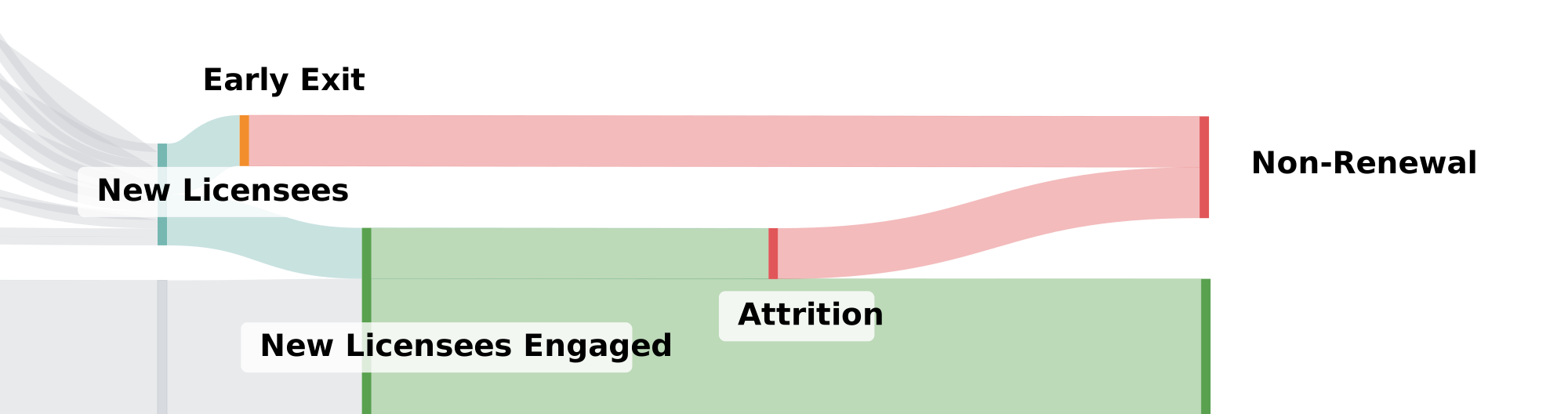
Exhibit 4.1. After-license view: post-grant engagement, attrition, and renewal flows.
4.2 Population Analysis
Track 1 examines two key populations:
Current Licensees (≈737,000 individuals)
- Full cross-section of engagement levels and interests
- All license classes and activity preferences
- Both highly active and minimally engaged operators
- Diverse participation modes and focus areas
- Recent licensees through long-term participants
Former Licensees
- Focus on recent non-renewals (last 24 months)
- Particular attention to grace period cases
- Analysis of activity patterns pre-lapse
- Examination of reactivation patterns
- Identification of leading indicators
4.3 The FCC ULS Advantage
The FCC Universal Licensing System provides unique analytical capabilities:
- Population-level data covering ~737,000 current licensees
- 25+ years of licensing history
- Complete upgrade and renewal patterns
- Geographic distribution analysis
- Temporal progression tracking
This enables analysis that would be impossible through conventional sampling methods, particularly for understanding participation patterns and engagement trends.
4.4 Engagement Scoring
A special feature we have added to support this analysis is a multi-factor engagement model. The Engagement Score will be used to assess health of various segments of the licensed population and as a predictive indicator of likelihood to continue or exit.
These are some of the attributes we plan to collect in the survey to drive calculation of an Engagement Score:
- Operating activities and preferences
- Community involvement and leadership
- Infrastructure access and utilization
- Emergency communications participation
- Educational and mentoring roles
- Technical project involvement
- Event participation (field day, contests, etc.)
This creates a comprehensive framework for measuring participation strength and predicting retention risk.
4.5 License Lifecycle and Trajectory Analysis
Four critical transition periods are of great interest in this research. We will want to understand Engagement levels at and leading up to these important moments in the licensing journey:
-
First 6 Months Post-License
-
Mid-Term Development (6-36 months)
-
Pre-Expiration Period (Final 6 Months)
-
Post-Expiration Window
Exhibit 4.2 uses the license lifecycle as a measurement scaffold. A license event does not automatically tell us engagement depth; the goal is to identify common journey patterns and develop the ability to predict them over time — and to invest in programs that will reduce the frequency of attrition where it is preventable.
%%{init: {
  "flowchart": { "nodeSpacing": 55, "rankSpacing": 70, "curve": "basis" },
  "themeVariables": { "fontSize": "18px", "nodePadding": 14 }
}}%%
flowchart TB
  A["Initial License"] --> B["Renewal Window"] --> C["Expiration"] --> D["End of Grace"]

  T1["Thriving"] -.-> O1["On-time Renewal"]
  T2["Steady"] -.-> O1
  T2 -.-> O2["Grace Renewal"]
  T3["Drifting"] -.-> O2
  T3 -.-> O3["No Renewal"]
  T4["Early Exit"] -.-> O3
  T5["Immediate Exit"] -.-> O3

  A -.-> T1
  A -.-> T2
  A -.-> T3
  A -.-> T4
  A -.-> T5

  %% Styling (matched to long-form exhibit palette)
  classDef anchor fill:#ffffff,stroke:#111111,stroke-width:2px;
  classDef red fill:#fff5f5,stroke:#c53030,stroke-width:2px;
  classDef orange fill:#fffaf0,stroke:#dd6b20,stroke-width:2px;
  classDef green fill:#f0fff4,stroke:#2f855a,stroke-width:2px;

  class B,C,D anchor;
  class A,T1,O1 green;
  class T2,T3,O2 orange;
  class T4,T5,O3 red;
Exhibit 4.2. FCC lifecycle and engagement trajectory frame linking cross-sectional snapshot findings to common journey patterns.
These trajectory patterns become the intervention map and segment playbook that show where ARDC can invest with the highest practical leverage.
With the target population strategy and confidence posture established, the next section describes the program design and sequencing used to produce early outputs and integrated findings.
4.6 Participation Segmentation
Segmentation will allow us to discover patterns that are associated subgroups within the broader population. We will plan to explore attitudes, behaviors and Engagement in subgroups by:
-
License Class
-
Activity Preferences
-
Geographic Patterns
4.7 Track 1 Workflow
High-quality, controlled-sample surveys are costly to run. When mail is used as the outreach method, there is no refund from the Post Office if the survey was faulty and produced inconclusive or biased results. It is very important to invest the time and effort to ensure that the survey will deliver the quality results that the team expects to achieve. This has significant implications on the survey design and testing process. In the workflow shown in Exhibit 4.3, key steps of Qualitative Discovery and Pilot Testing are included to help ensure a high-quality result set will be delivered.
Track 1 Workflow - Current and Former Licensees
1. Charter and Design Lock
Scope, sample assumptions, quality thresholds, and gate criteria confirmed.
2. Qualitative Discovery and Instrument Build
Expert interviews surface full breadth of data collection requirements. Qual signal translated into measurement batteries and survey draft.
-> Output to WS2 setup: segment and message signals for Stage 2 alignment.
3. Cognitive Testing and Pilot Gate
Comprehension and operations validated before full launch approval.
4. Full Survey Execution
ULS sample fielding with response monitoring.
5. Analysis and Track 1 Reporting
Snapshot, trajectories, and investment levers for licensed populations.
-> Output to integration: Decision Kit inputs and board-ready briefings.
Exhibit 4.3.Overview of Track 1 project flow with quality gates and handoffs.
5. Track 2 — Acquisition
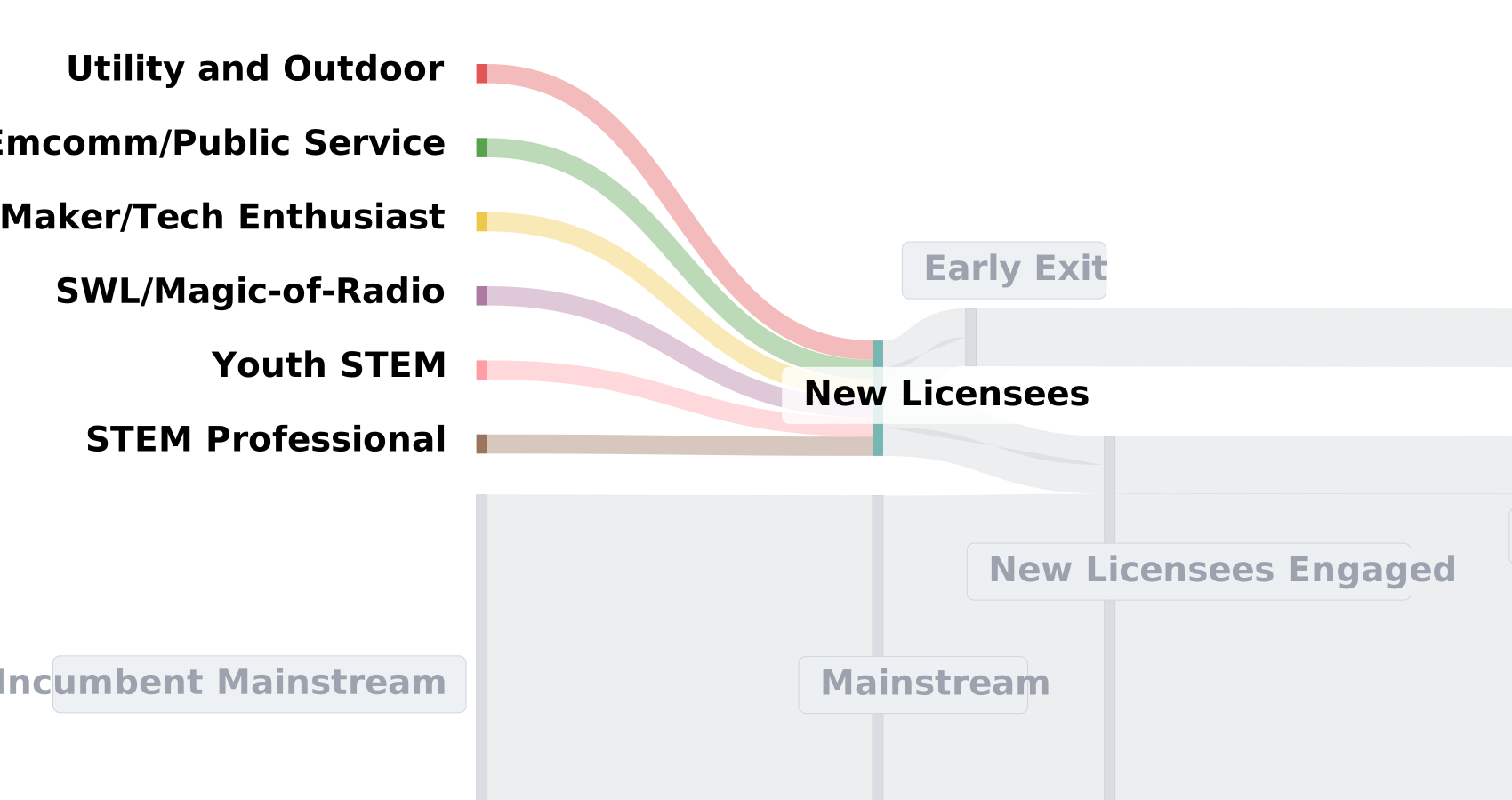
Exhibit 5.1. Entry pathways showing progression to initial licensing.
5.1 Purpose
Track 2 maps the diverse pathways and feeder channels by which new participants enter into amateur radio. It examines how different entry points - from emergency communications and community service to technical experimentation and digital modes - create awareness, build interest, and lead to licensing. This analysis will help ARDC identify which entry channels most effectively create engaged participants across the full spectrum of amateur radio activities.
5.2 Entry Progression Framework
With so many different paths to an amateur radio license, we need a common lens through which we can evaluate and compare. To satisfy that need for a common framework, we can use a generalized model that captures the path every prospective ham takes. The model shown below in Exhibit 5.2 reflects that path, traversing four stages-from complete unawareness of amateur radio to receiving a license and callsign.
But, not every prospective ham successfully traverses the entire path. There are opportunities to drop out all along the way. In this part of the research, our goals are to:
-
Discover how and why prospective amateur radio participants either make it through to receiving a license, or drop out somewhere along the way, and
-
Understand the role of the channels in shaping that path.
%%{init: {"flowchart": {"htmlLabels": true}} }%%
flowchart TB
A["<div style='text-align:left; line-height:1.35;'><strong>Initial Discovery</strong><br/>• Learns of amateur radio<br/>• Finds personal relevance<br/>• Matches existing interests<br/>• Barrier perception formation</div>"]
B["<div style='text-align:left; line-height:1.35;'><strong>Interest Development</strong><br/>• Activity exploration<br/>• Knowledge-seeking<br/>• Community connections<br/>• Resource identification</div>"]
C["<div style='text-align:left; line-height:1.35;'><strong>Licensing Intent</strong><br/>• Preparation commitment<br/>• Study resource selection<br/>• Find community support<br/>• Timeline establishment</div>"]
D["<div style='text-align:left; line-height:1.35;'><strong>License Achievement</strong><br/>• Exam preparation<br/>• Knowledge development<br/>• Testing session complete<br/>• Initial license issued!</div>"]
A --> B --> C --> DExhibit 5.2. Model licensing pathway used for evaluaton and comparison of various entry channels.
5.2 Entry Channels
The most common path to an amateur radio license involves connecting with one or more groups or individuals that support newcomers to amateur radio. This support network aids the process of getting new hams licensed, from early demonstrations and discussions to training classes for license testing and running the VE testing sessions. The paths to an amateur radio license are quite varied. In some cases, a single group can handle the entire end-to-end process. In other cases, an aspiring ham will get assistance for different parts of the journey from different parts of the support network. Some of the players in this network are noted below.
Community-Based Channels
- Local radio clubs
- Emergency response groups
- Public service organizations
- Educational institutions
- Maker spaces
Service-Oriented Paths
- Emergency communications teams
- Public event support
- Disaster preparedness groups
- Search and rescue organizations
- Weather spotting networks
Educational Channels
- STEM programs
- Radio clubs in schools
- Technical education centers
- Mentorship programs
- Training workshops
One of our goals in the research is to identify the most common feeder channels into amateur radio and to characterize them. To do this we will identify examples from many of the categories and capture data about how they work. Our expectation is that certain models will emerge as the most common and and mature.
Some of the feeder channel data we plan to collect are these measures:
- Participant engagement levels
- Conversion effectiveness
- Support system strength
- Resource requirements
- Scalability potential
This data will help us identify gaps and opportunities to make the amateur radio feedr system more robust.
5.5 Evidence Sources
How will we capture the data we need to build the map and model? Because this is a very diverse group, we cannot easily use a survey to capture the data we need. Instead, we plan to spend time with leaders from the various feeder channels to learn what makes them work and what impediments they face:
Entry Channel Leaders
Performed as guided Expert Interviews, we will build profiles of the key entry channels:
- Club officers
- Emergency coordinators
- Education directors
- Program organizers
- Community leaders
Recent Licensees
- Survey Research
Here again, the FCC ULS Database carries the information we need to select a representative sample of Recent Licensees. We will be able to capture information about the licensing paths that they followed and their experience navigating the process.
- Licensee Interviews
We can enrich the quantitative survey findings with a qualitative perspective through interviews with selected Recent Licensees
We'll be exploring the licensing experiences of:
- Service-oriented entrants
- Community-focused participants
- Technical enthusiasts
- Educational program graduates
- Emergency communications volunteers
5.6 Track 2 Deliverables
Key outputs include:
-
Entry Map
- Channel effectiveness ratings
- Conversion metrics by path
- Quality scoring framework
- Resource requirement guides
- Scalability assessments
-
Investment Guidelines
- Opportunity evaluation criteria
- Cost-effectiveness benchmarks
- Risk assessment frameworks
- ROI calculation methods
5.7 Track 2 Workflow
High-quality, controlled-sample surveys are costly to run. When mail is used as the outreach method, there is no refund from the Post Office if the survey was faulty and produced inconclusive or biased results. It is very important to invest the time and effort to ensure that the survey will deliver the quality results that the team expects to achieve. This has significant implications on the survey design and testing process. In the workflow shown in Exhibit 4.3, key steps of Qualitative Discovery and Pilot Testing are included to help ensure a high-quality result set will be delivered.
Track 2 Workflow - Entry Paths for New Licensees
1. Segment Prioritization and Access Strategy
Priority segments and feasible access paths across partner channels, screened panels, and targeted outreach.
2. Source Qualification and Inference Posture
Coverage and bias risks evaluated; confidence limits set per segment.
-> Output to governance: approved source strategy and confidence assumptions.
3. Qualitative Input and Instrument Design
Segment-specific signal shapes questions, language, and pathway measures.
4. Multi-Channel Fielding and Monitoring
Channel-level quality checks with optional benchmark module activation.
5. Cross-Segment Synthesis and Reporting
Opportunity mapping and recommendations with explicit inference boundaries.
-> Output to integration: Decision Kit inputs, partner implications, continuity metric candidates.
Exhibit 5.3. Overview of Track 2 project flow with quality gates and handoffs.